Why geography matters in EV charging
July 6, 2026
The greatest challenge facing British EV drivers is not the quantity of chargers; it’s where they are.
Britain’s public EV charging network is expanding faster than ever before but, as the number of chargers continues to rise, a new challenge is emerging. The next phase of the UK’s EV transition is not simply about installing more chargers – it’s about ensuring that all parts of the country benefit from it.
In this insights piece, we explore why geographical disparities in charging provision matter, what they mean for drivers and businesses, and why building chargers where they’re needed most, rather than just where it’s easy to build, should be the sector’s priority.
It wasn’t that long ago that the debate around EV charging centred on the question of whether the UK would be able to build enough charging infrastructure to support the EV transition. Today, that question feels like it’s increasingly being answered.
As of April 2026, the Department for Transport (DfT) figures show that the UK had more than 119,000 public EV chargers, including over 27,000 rapid and ultra-rapid chargers with more than 3,000 new chargers added during the first quarter of 2026 alone.
Public charging is increasingly looking like one of the UK’s genuine infrastructure success stories, but success can sometimes create new challenges. As the network grows, the conversation is now shifting away from ‘how many chargers does the UK have?’ to ‘where are they?’
Drivers don’t experience national averages
National statistics tell one story, but drivers invariably experience another.
Depending on where you live, your experience driving an EV may be completely different to someone else’s in another part of the country. One driver may have public rapid charging within minutes of their home, while another may need to travel considerably further or carefully plan every longer journey based on chargers on their route and at their destination.
The latest Department for Transport figures illustrate that reality.
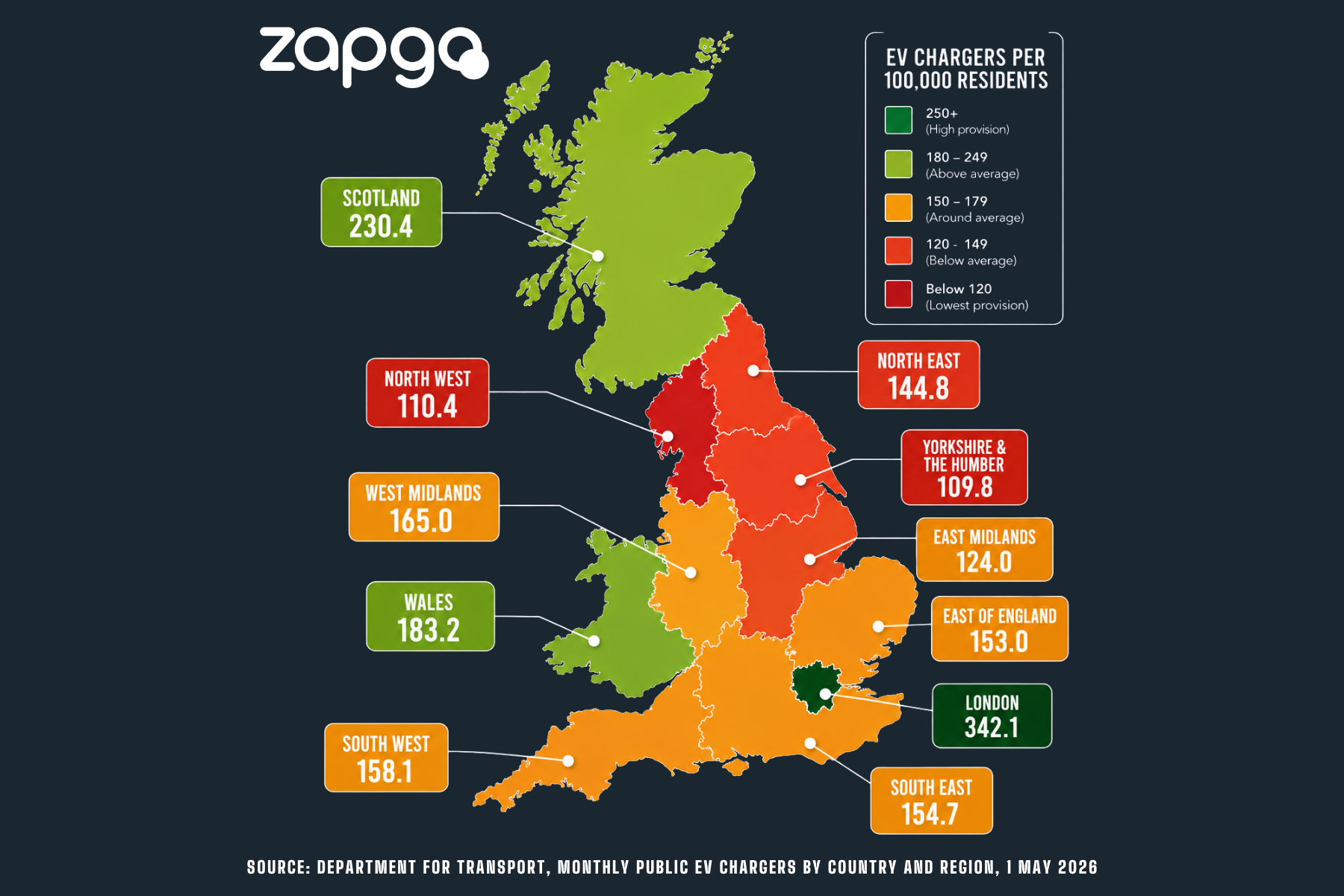
London now has 342.1 EV chargers per 100,000 residents, whereas the North East only has 144.8 EV chargers per 100,000 residents (the Great Britain national average is 177.1 EV chargers per 100,000 residents). If we look only at rapid and ultra-rapid charging, the North East, with 35.4 rapid/ultra-rapid chargers per 100,000 residents still lags far behind the South West, with 48.6 rapid/ultra-rapid chargers per 100,000 residents and the Great Britain national average of 41.2 rapid/ultra-rapid chargers per 100,000 residents.
Even in regions where the statistics suggest there is high charging provision, you will still find a significant number of areas where drivers experience ‘charging deserts’, particularly away from the urban centres in areas with low population density, such as rural Scotland.
To look only at statistics, however, risks missing the full picture. If you consider what impact these have on drivers, when they’re travelling with their families and can’t seem to find a rapid or ultra-rapid charger anywhere, it influences driver confidence, their purchasing decisions and the willingness of households and businesses to make the switch to electric. If drivers can’t be confident they’ll find rapid, reliable and convenient charging wherever they live, work or travel, adoption inevitably suffers.
Not all chargers serve the same purpose
Headline national charger numbers only tell part of the story and simply counting the number of installations across the country can mask important differences in how the network supports drivers.
A slower on-street charger in a city helps residents without off-street parking charge overnight but rapid and ultra-rapid destination charging, like the ones we install at Zapgo, allow drivers to charge up their car quickly in the background while they enjoy their destination before their journey home. Rapid and ultra-rapid charging, particularly at destinations, enables drivers to continue longer journeys with confidence and recharge while shopping, eating, playing sport, or visiting local attractions.
More than half of the UK’s public charging network is now made up of destination charging, reflecting the growing importance of placing chargers where people naturally spend their time rather than expecting drivers to make dedicated trips just for the sake of charging. This means that the future of EV charging is not simply about adding more pins to the charging map. Instead, it’s about building the right infrastructure in the right places.
Closing the regional gap brings economic opportunity
Improving regional charging provision and reducing the geographical disparity is not just about helping drivers themselves – it’s also good for the local economy. Reliable public charging attracts visitors, increases dwell time and encourages additional spending at nearby businesses.
Pubs, cafés, hotels, sports clubs, garden centres, retail parks and tourist destinations all stand to benefit each time a driver chooses to spend time enjoying the local area while their vehicle charges. This means that those communities who are stuck with only limited charging infrastructure are missing out on more than just charging capacity – they’re also at risk of missing out on new visitors, additional customer spending, and the inward investment that EV drivers bring.
As driving an EV becomes the norm rather than the exception, visitors will increasingly expect charging infrastructure at every destination they go to.
Building chargers where they’re needed most
We strongly believe that the next phase of the UK’s charging rollout should focus on communities and regions that have been overlooked so far, rather than simply reinforcing areas where charging provision is already strongest.
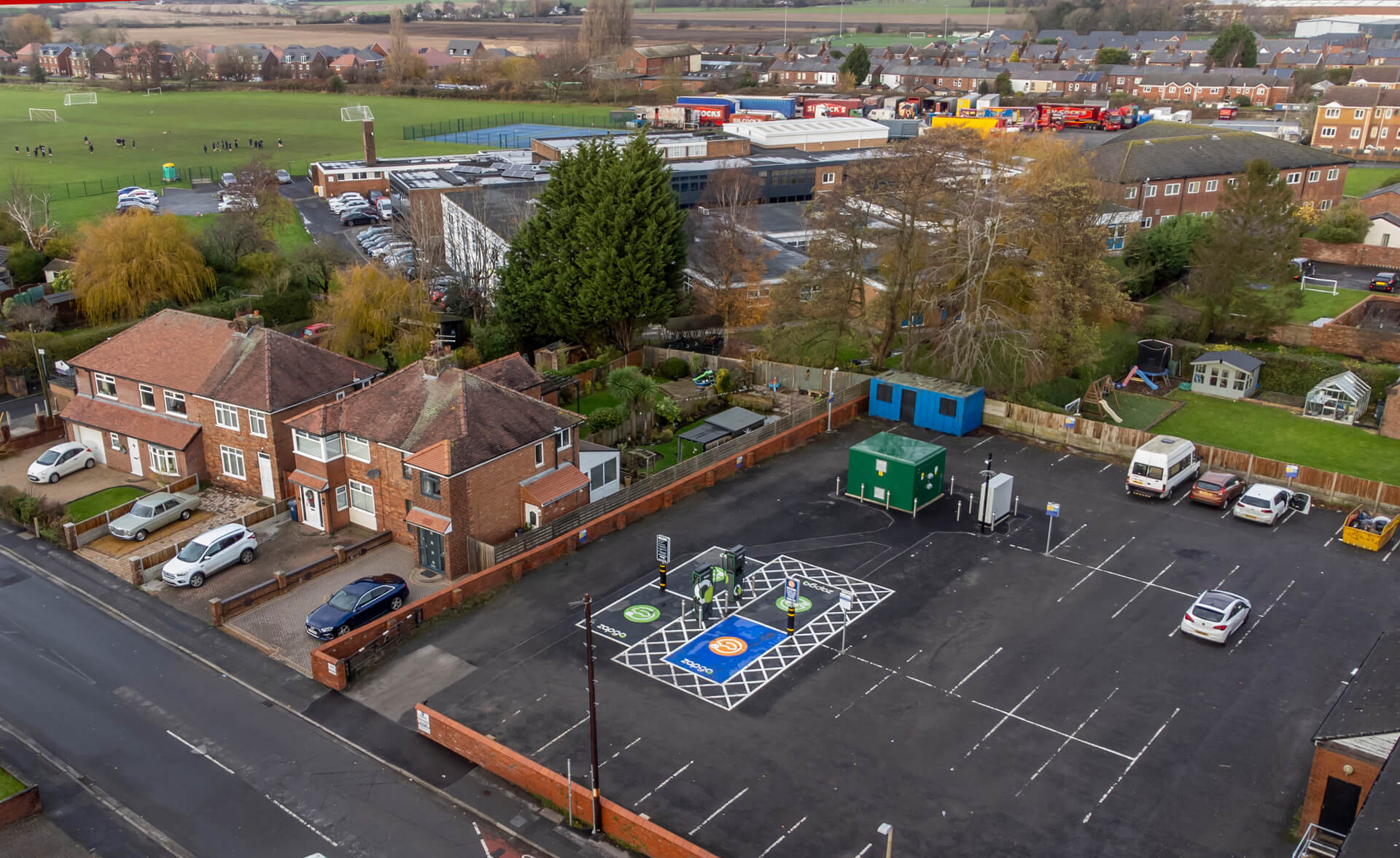
This philosophy continues to shape the way we’ve been building our charging network. With live sites in historically underserved regions including Somerset, Lancashire, Dumfries & Galloway and Tyne and Wear, and upcoming sites in Cumbria, Perth and Ayrshire and more, we’re actively leading the charge in delivering rapid and reliable charging where it can make a meaningful difference to drivers and local businesses.
Not only are we targeting underserved regions but, by partnering with hospitality venues, retailers, sports clubs and more, we are bringing chargers closer to the places people already want to visit, all while supporting the local economy and giving drivers greater confidence to go further.
The next phase
As a country, we have every reason to be proud of the progress we have made so far: our public charging network continues to grow at an impressive pace while our EV sales figures also cement Britain’s status as a brilliant place to embrace new technologies.
The challenge now, however, is to ensure that investment in a rapid and reliable charging network reaches every part of the country. At Zapgo, we’re already playing our part in making this happen with sites like Fussels, the Stanley Club, and Callerton in underserved communities – but there’s more to be done.
The success of our role in the EV transition won’t be measured just by how many chargers are built but by how many communities we bring with us in making the switch to electric.